

CEF support to Rhine-Danube Corridor - May 2020
CEF support to Rhine-Danube Corridor - April 2018
CEF Transport projects by country
Overview
The Rhine-Danube Corridor provides the main east-west link across Continental Europe. Tracing its route along the Danube River, it connects Strasbourg and Southern Germany with the Central European cities of Vienna, Bratislava and Budapest, before passing through the Romanian capital Bucharest to culminate at the Black Sea port of Constanta. A second branch of the corridor tracks a path from Frankfurt to the Slovakian/Ukrainian border, linking Munich, Prague, Zilina and Kosice. Key projects situated along the corridor include improvements to the Good navigation status of the Danube River in all the riparian countries.
Main bottlenecks and missing links
The main missing links are cross-border rail network connections between Germany and its neighbours, France, Austria and the Czech Republic. Bottlenecks in Slovakia, Hungary, Romania and Bulgaria—and between Austria and Slovakia also need to be addressed. Navigation of the Rhine River and its connection with the Rhine-Main-Danube Canal are of a high standard, but must be matched by the Danube River if these inland waterways are to offer a genuine alternative modal choice as an unbroken, integrated corridor for freight transport. In addition, the Western Balkans section of the Danube plays an important part in the functioning of this corridor and must therefore attain similar high standards.
Success stories
Czech Republic aims with its railway projects to upgrade the rail infrastructure in order to eliminate the existing capacity and interoperability bottlenecks along the three Core Network Corridors crossing the country: Rhine-Danube, Orient-East Med and Baltic Adriatic. Most of these actions are in their early stages of implementation. Several sections of the Rhine – Danube Core Network Corridor will be upgraded in 2019 or 2020.
Romania focuses on the rehabilitation and the upgrade of the existing railway line between Braşov and the Hungarian-Romanian border, thereby removing the bottleneck between Braşov and Sighișoara. Because of changes in the procurement laws, the construction works will only start in autumn 2017, one year later than initially foreseen
The project "FAIRway Danube", which sees the involvement of Austria, Slovakia, Hungary, Romania, Croatia and Bulgaria, aims to ensure cooperation among the waterway administrations of the riparian countries to facilitate the sharing of best practices to successfully implement works projects. This action is very relevant as it delivers twice a year National Action Plans to provide information on the fairway conditions and planned projects. The process for the acquisition of the necessary mobile equipment to carry out hydrological investigations and marking operations for a safe and more reliable navigation is almost completed.
The action "FAST Danube" located along the Romanian-Bulgarian Danube common section intends to develop an integrated concept to ensure a good navigation status and identify the capital dredging works in the Romanian-Bulgarian common section.
The "Upgrade of the Gabčíkovo locks" is the large scale first infrastructure Action financed through CEF and covers the replacement/reconstruction of several infrastructure components of the locks to increase safety and reliability of navigation, removing an important bottleneck in the Slovak section of the Danube.
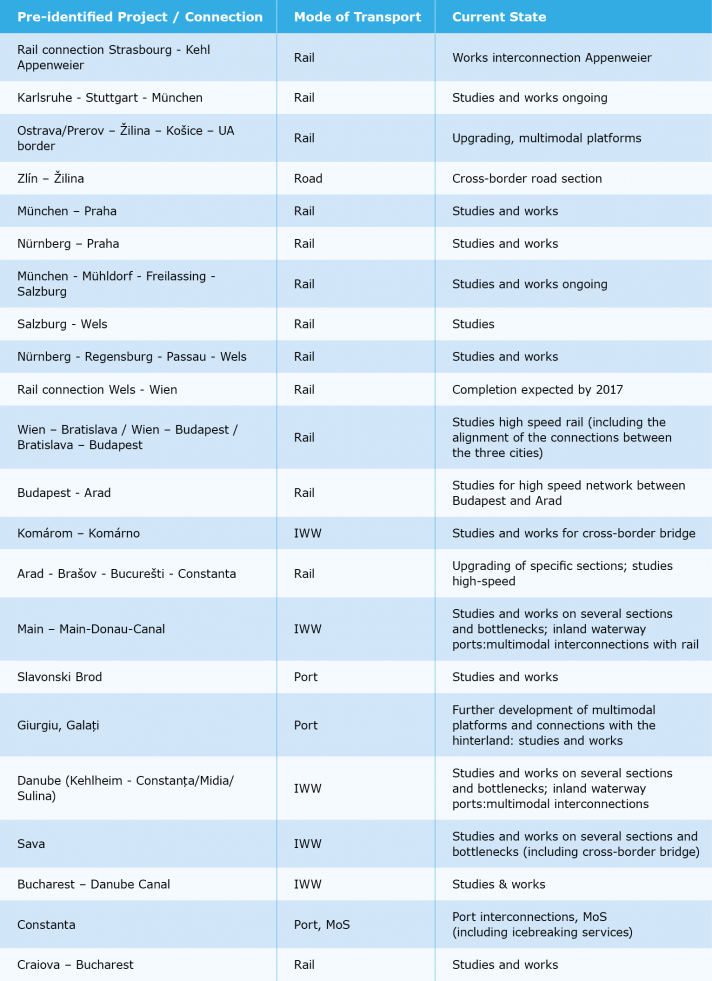
CEF: Pre-identified projects
European Coordinator for the TEN-T Rhine-Danube Corridor, Ms Ines Ayala
Inés Ayala Sender is European Coordinator for the Rhine-Danube Core Network Corridor as of 1st January 2021, following Ms Karla Peijs.
Inés Ayala Sender was born on 28 March 1957 in Zaragoza (Spain). She was associated teacher at the University of Zaragoza (1981 – 1991), Member of the National Board of UGT Trade Union, Madrid (1990 – 1994), Deputy General Director FUNDESCOOP (social economy EU programs) (1994 – 1995), National expert at EC DG XI (Environment) (1995-1997), European Parliament administrator for S&D in ENVI, REGI and TRAN committees (1997-2004) and Member of the European Parliament in TRAN, ENVI, CONT, SEDE, FEM (2004-2019). From 2019 until now, she is elected member of the City Council of Zaragoza.
Ms Ines Ayala Sender, European Coordinator
Ines [dot] AYALA-SENDER ec [dot] europa [dot] eu (Ines[dot]AYALA-SENDER[at]ec[dot]europa[dot]eu)
Mr. Alain Baron, Adviser of the European Coordinator
Alain [dot] Baronec [dot] europa [dot] eu (Alain[dot]Baron[at]ec[dot]europa[dot]eu)
Postal address:
Rhine-Danube CNC / TEN-T
Directorate-General for Mobility and Transport
Rue de Mot 28
1049 Brussels
Belgium
Maps
Rhine-Danube TEN-T Corridor Compliance Maps
Rhine-Danube TEN-T Corridor Map
Workplans
1st Rhine-Danube TEN-T Corridor work plan
2nd Rhine-Danube TEN-T Corridor work plan
3rd Rhine-Danube TEN-T Corridor work plan
4th Rhine-Danube TEN-T Corridor work plan
Studies
Rhine-Danube Core Network Corridor Study (2014)
Rhine-Danube Core Network Corridor Study annexes (2014)
Study on Rhine-Danube TEN-T Core Network Corridor (2017)
Study on Rhine-Danube TEN-T Core Network Corridor - Western Balkans (2017)
Study on Rhine-Danube TEN-T Core Network Corridor - Executive Summary (2017)