
Welcome to the Alliance
The Renewable and Low-Carbon Fuels Value Chain Industrial Alliance is an initiative dedicated to advancing the production and supply of renewable and low-carbon fuels in the aviation and waterborne sectors. We are a crucial component of the FuelEU Maritime and RefuelEU Aviation Regulations, working hand-in-hand to drive the transition towards a more sustainable future.

Who we are
The Alliance is a collaborative effort that began on April 6, 2022. It brings together a diverse range of stakeholders from the transport fuels and related value chains. Our members include industry leaders, technology and finance providers, civil society organisations, government bodies, and more. We connect both the supply and demand sides of the aviation and waterborne sectors, as well as various stakeholders engaged in fuels production and related activities.

Our vision
The objective of the Alliance is to ensure that aviation and waterborne transport have sufficient access to renewable and low carbon fuels, while taking into account the future use of these fuels in road transport, and thus contribute to the reduction in the transport sector’s GHG emissions by 90 percent by 2050. Currently, supply of these fuels is very limited and concentrated on road transport leaving aviation and waterborne transport far behind. Demand will quickly grow due to regulatory requirements of ReFuelEU Aviation and FuelEU Maritime. Therefore, particular focus is needed to develop fuel production, storage and distribution capacity for aviation and waterborne transport.

Membership benefits of RLCF Alliance
Collaboration & NetworkingConnect with industry leaders and policy makers.
Engage in knowledge-sharing.
Access exclusive events and roundtables.
Influence & ImpactShape industry initiatives.
Contribute to sustainability objectives.
Resources & SupportGrow projects’ visibility and bankability in the RLCF Pipeline.
Gain access to project development tools.
Learn about and access financial and technical assistance.
The RLCF Project Pipeline
The RLCF Alliance Project Pipeline is a pivotal initiative aimed at driving advancements in the development and operations of renewable and low-carbon fuel projects.
The pipeline provides a platform for project promoters to submit their innovative projects and join a network of industry leaders to jointly develop a supply chain for sustainable fuels. It supports industry efforts by offering matchmaking opportunities with up-stream and down-stream business partners, as well as connecting projects with potential financial supporters and policy makers.
Being part of this pipeline enhances project visibility and opens doors for strategic partnerships and collaborations; it also gives access to project development tools and link with possible technical assistance. Projects in the RLCF Pipeline benefit from higher visibility and a large network, supporting their projects’ growth, investment and business opportunities. Furthermore, projects in the pipeline can apply for the upcoming RLCF Alliance Seal of Excellence. This seal serves as a hallmark of quality and innovation, further cementing the status of those projects as frontrunners in the renewable and low-carbon fuel sector.
Complete Value Chain: all projects that can contribute to the future value chains of fuels supply for maritime and aviation sectors and fit in one or more project archetypes map. This includes sourcing, production, distribution and use of fuels, as well as any technology supplied that is needed for any stage in the value chain – including aircraft and vessels, refinery equipment, hydrogen production, CO2 sourcing and capture, etc.
Maturity: Projects can be at various stages of development, from early stages where you are looking for partners up-stream or down-stream, through projects who need financial backing, to projects near completion that need to increase visibility or off-taking.
Ownership: For projects located in the EU, the ownership of the production is not restricted. However, projects located outside EU can only be submitted if they are controlled by an EU entity or other significant link with the EU value chain can be demonstrated.
Location: Projects can be located in the EU or outside the EU. However, if your project is located outside EU and you are not an EU entity, additional justification of a link with the EU value chains will need to be demonstrated.
Scope of fuels: For projects that involve production or import of fuels would need to fall under the scope of technologies that can be used to fulfil legal requirements under the ReFuelEU Aviation or FuelEU Maritime regulations.
Destination of fuels: Projects that involve production of fuels and are located in the EU can produce maritime or aviation fuels for domestic uses or for exports. Projects located outside the EU need to demonstrate an intention to supply a majority of their production to parties who are obliged under the ReFuelEU Aviation or FuelEU Maritime, unless other significant links with the EU value chain can be demonstrated.
Sourcing of feedstock: As long as the feedstock is eligible under relevant EU legislation, projects can be supplied with feedstock for within the EU and outside.
Projects can be submitted by RLCF Alliance Members only. In case of projects involving multiple partners, all partners shall be members of the Alliance, or sign the alliance declaration at the same time with submission of the project to the pipeline.
Madoqua RenewablesThe Madoqua Synfuels project is a world-scale e-methanol project located in Pataias in the center of Portugal. Over the last two years, Madoqua Synfuels has been developed to comply with RED EU Regulations for the production of e-Methanol as a Renewable Fuel of Non-biological Origin (RFNBO), combining green hydrogen produced from renewable electricity and recycled CO2. Fuel type: RFNBO compliant e-methanol TRL: TRL 8 – System complete and qualified Transport Segment: Maritime |
ORLEN S.A.The "HyFly" project involves the construction of an installation for the large-scale production of synthetic fuels of non-biological origin (RFNBO) according to the Fischer-Tropsch (F-T) technology using RFNBO hydrogen and biogenic CO2. Thanks to the "HyFly" project, it will be possible to achieve a production capacity of approximately 70 kt/year of synthetic hydrocarbons, including high-quality synthetic, sustainable e-Jet RFNBO aviation fuel and valuable raw materials for petrochemicals. One of the main advantage of the "HyFly" project is its innovation using digital solutions. The first is real-time management of molecules, i.e. directing remaining products to appropriate refining and petrochemical installations in order to maximize the highest-margin products. The project will enable the implementation of CO2 emission reduction goals and the goals resulting from the ReFuelEU Aviation regulation implemented in Oct 2023 regarding the share of RFNBO and SAF in produced aviation fuels. Fuel type: E-kerosene RFNBO and e-lpg/e-naphtha TRL: TRL 8 – System complete and qualified Transport Segment: Aviation |
Uniper SESkyFuelH2 is an industrial-scale project for production of SAF. It will combine in a first-of-a-kind way electrolysis for hydrogen production, gasification of dried and torrefied biomass, Fischer-Tropsch technology for conversion of the syngas to crude and onsite hydro-treatment of the crude and workup for large-scale production of SAF and Sustainable Naphtha. The project is located in Northern Sweden, in the community of Solleftea, one of the most favorable regions with regards to renewable power supply and sustainable biomasses. The so-called power-and-bio-to-liquid process (PBtL) is achieving >90% more SAF yield than a pure BtL process and >10% more yield than two separate PtL and BtL processes. Fuel type: SkyfuelH2 is aiming to produce ca 77 kt/a of FT-SPK. The SAF from SkyFuelH2 will comply with ASTM D7566 Annex 1.The GHG reduction is between 88 to 95% (depending on the biomass sourcing distance). Besides, SkyfuelH2 will produce ca 16 kt/a of Sustainable Naphtha. TRL: TRL 8 – System complete and qualified Transport Segment: Aviation |
FF Frontier Fuels GmbHWith this project, we aim to conduct a small-scale pilot using our newly developed marine biofuel, Bloom E. This is our residual-grade biofuel that can be used as a drop-in solution in ocean-going vessels. This project involves the bunkering of 150 tons of a B30 biofuel and the monitoring of performance over roughly one week. Preparations include obtaining approval from engine manufacturers and classification societies, as well as working with a physical supplier for the fuel delivery. Preparatory onshore engine tests with a third-party laboratory are also possible. We aim to collaborate with innovative shipping companies interested in exploring the potential of novel biofuels to significantly reduce their greenhouse gas emissions. Further opportunities for collaboration include working with physical suppliers for the provision of the fossil component and handling of the bunkering process, as well as engaging with experts from regulatory agencies or classification societies. Fuel type: Liquid Marine Biofuels TRL: TRL 5 – Technology validated in relevant environment (industrially relevant environment in the case of key enabling technologies) Transport Segment: Maritime |
Vital Energy IncThermal Gasification technology; converting non recycled MSW and other waste fractions compliant to RED II (dry waste / not oils) to renewable power and RFNBO fuel green methanol. Our process feedstock does not include oils. Fuel type: Green methanol plus the potential for other hydrocarbon fuels. TRL: TRL 9 – Actual system proven in operational environment (competitive manufacturing in the case of key enabling technologies; or in space) Transport Segment: Maritime |
Tree Energy SolutionsTES’s aim is to produce electric natural gas, e-NG which is a product of biogenic CO2 and green hydrogen. We will produce e-NG in locations characterised by an abundance of renewable energy within and outside the European Union. The most advanced projects are in Texas, US and in Canada. We are also developing projects within the European Union and a large import hub for e-NG in Wilhelmshaven, Germany. The applied technologies are existing and proven technologies. Two components will be the foundation of e-NG: green hydrogen and biogenic CO2. Green hydrogen will be produced via electrolysis including power from a renewable energy source; depending on the location this will be either wind or solar energy. To ensure that the electrolyser is always sufficiently supplied, an energy storage will be connected as well. The Sabatier reactor will transform green hydrogen and biogenic CO2 into e-NG which can be supplied to customers via the existing gas infrastructure. Fuel type: electric natural gas, e-NG TRL: TRL 9 – Actual system proven in operational environment (competitive manufacturing in the case of key enabling technologies; or in space) Transport Segment: Maritime |
Arcadia eFuelsArcadia eFuels will achieve our purpose by creating net zero carbon fuels that use existing infrastructure and work in existing engines. Our solution uses proven technology in a novel way to meet the significantly outpaced market demand. We intend to build multiple plants that will each produce 75,000 tons, or 100 million liters, of eFuels per year. Specifically, we’ll produce eDiesel and electro sustainable aviation fuel to power the transportation sector. Arcadia eFuels is advanced for the site in Vordingborg, Denmark and are currently in development for multiple other sites worldwide. We have finalized FEED (Basic engineering), have grid connection and secured CO2. Permitting is all handed in and we will be in public hearing mid 2024. Fuel type: We will produce eSAF for the aviation sector within the EU, all eSAF will be according to RFNBO-regulations TRL: TRL 9 – Actual system proven in operational environment (competitive manufacturing in the case of key enabling technologies; or in space) Transport Segment: Aviation |
RepsolRepsol has been developing the Ecoplanta Molecular Recycling Solution (Ecoplanta) project for several years, together with Enerkem as technological leader. It would be the first plant in Spain for non-recyclable municipal solid waste recovery into circular methanol that would be used to manufacture new materials and advanced biofuels. It is planned to be located in El Morell (Tarragona). The plant, which is expected to start operations in 2029 after the FID made in January 2025, will process around 400,000 tonnes of non-recyclable municipal solid waste per year, mainly from ecoparks (waste recovery and treatment plants) in nearby towns, which would be equivalent to the waste generated in a year by a population of 800,000 people, thus avoiding the use of virgin raw materials. Around 240,000 tonnes of circular methanol will be produced from this waste, which serves as a raw material for the production of circular materials and advanced biofuels. Fuel type: Bio-methanol TRL: TRL 8 – System complete and qualified Country: Spain Transport Segment: Maritime, Aviation |
IneratecINERATEC is leading the transformation toward a fossil-free future with its pioneer project in Frankfurt Höchst. They are currently building the world’s largest Power-to-Liquid (PtL) plant for the production of sustainable, climate-friendly e-Fuels and e-Chemicals. Beginning in 2025, the plant will recycle up to 8,000 metric tons of CO2 annually, converting it into 2,500 tons of e-Fuels and chemicals. Targeting hard-to-abate sectors like aviation, shipping, and heavy-duty transport, INERATEC provides sustainable solutions such as Sustainable Aviation Fuel (SAF) and synthetic diesel to give those sectors the possibility to reduce their emissions and become decarbonized. This project not only marks INERATEC’s first fully self-operated facility but also represents a global blueprint for future PtL plants worldwide. Fuel type: We are willing to produce norm-conform drop-in ready eSAF, e-diesel, e-marine diesel, e-gasoline and e-methanol. TRL: TRL 7 – System prototype demonstration in operational environment Country: Germany Transport Segment: Maritime, Aviation |
SkyNRGSkyNRG and Skellefteå Kraft are entering a Joint Venture under the name Project SkyKraft, an innovative and large-scale project initiated in 2022. The project will further investigate the opportunity to produce 100,000 tonnes/y Sustainable Aviation Fuel (SAF) from renewable electricity and biogenic CO2, known as eSAF. This project will be among the first of its kind globally, positioning Northern Sweden as a leader in the energy transition. eSAF from Project SkyKraft will support the EU’s decarbonization goals and further enhance Skellefteå’s position as Sweden’s hub for next-generation green industry, creating opportunities for the aviation industry to reach net zero emissions. Fuel type: eSAF / eNaphtha. TRL: TRL 8 – System complete and qualified Country: Sweden Transport Segment: Aviation |
Madoqua RenewablesMadoquaPower2X (MP2X) is a world leading Renewable Fuel of Non-Biological Origin (RFNBO) hydrogen to ammonia project. It is strategically located at the Sines Industrial and Logistics Zone (Zona Industrial e Logística de Sines, ZILS) in Southwest Portugal. MP2X is jointly developed by a consortium consisting of Madoqua Renewables (Portugal), Power2X (Netherlands) and Copenhagen Infrastructure Partners (CIP), via its Energy Transition Fund I (CIP) (Denmark). The consortium is committed to developing, installing, and operating the new generation industrial plant to the highest environmental and safety standards. The facility will have a nameplate capacity of 1,150 tonnes/day (equivalent 419,750 tonnes/annum) of RFNBO ammonia and will utilise between 50,000 to 60,000 tonnes/annum of RFNBO hydrogen produced with electrolyzer capacity of 500 MW. The produced hydrogen and ammonia are RFNBO compliant in line with the requirements of the REDII and REDIII Delegated Acts. Fuel type: green amonnia and green hydrogen TRL: TRL 8 – System complete and qualified Country: Portugal Transport Segment: Maritime |
Exolum Corporation S.A. (Exolum)ECO2FLY is an innovative initiative aimed at decarbonizing the construction materials industry and transforming synthetic aviation fuel (e-SAF) production through a fully integrated value chain. Led by P2X Spain, Holcim, and Exolum, the project will significantly reduce carbon emissions in the aviation and cement sectors while complying with RED III obligations. It will capture over 700,000 tonnes of CO2 annually from Holcim’s Villaluenga cement plant, with half converted into e-SAF—meeting 15% of Europe’s demand by 2031—while the rest is stored in geological formations across Spain. With a €4 billion investment, it will prevent 7 million tonnes of CO2 emissions in ten years, create 900 operational jobs and 2,500 annual construction jobs, and drive over 1 GW of new renewable energy capacity. ECO2FLY marks a decisive step towards sustainability, merging innovation, industry collaboration, and economic growth. Fuel type: The fuel developed is e-Sustainable Aviation Fuel. It is synthesized from captured CO₂ and RFNBO hydrogen. This synthetic aviation fuel has 80% lower GHG emissions than conventional jet fuel and is fully compatible with existing aircraft and infrastructure, supporting the decarbonization of the aviation sector TRL: TRL 8 – System complete and qualified Country: Spain Transport Segment: Aviation |
RIC ENERGY HOLDINGS, S.L.Compostilla Green is a flagship project aimed at producing sustainable aviation fuel (eSAF), positioning Spain at the forefront of the energy transition and the decarbonization of air transport. This strategic initiative will generate over 2,000 jobs during the construction phase and 250 direct jobs in operation in Cubillos del Sil (León)—a municipality classified as a demographic challenge area and included in the Just Transition Agreement for Bierzo-Laciana in Castilla y León. The project will deliver 60,000 tonnes of FT-SPK annually, leveraging a 250 MW green hydrogen production facility and biogenic CO₂ captured from a nearby biomass plant. Compostilla Green was ranked first in Spain’s Hydrogen Valleys program, securing significant public funding to accelerate its development. Currently, the project is advancing through environmental permitting and has initiated Class IV engineering, marking a critical step toward execution. Fuel type: Green and low carbon eSAF and eNaphtas TRL: TRL 8 – System complete and qualified Country: Spain Transport Segment: Aviation |
Hynamics - EDF groupThe TAKE KAIR project will demonstrate the viability of a synthetic sustainable aviation fuel (SAF) production plant at industrial scale. These fuels, derived from renewable and low-carbon hydrogen produced by electrolysis of water and captured CO2, are critical to reducing the carbon intensity of aviation, alongside biofuels, which are limited by biomass availability, and the improvement of aircraft efficiency. Located in the port of Saint-Nazaire (Donges, Pays de la Loire), the plant will source CO2 captured from local emitters and will integrate a large-scale electrolyser to supply the hydrogen in order to produce annually about 50,000 tons of e-fuel (SAF & naphtha). The project will enable the scaling-up of synthesis technologies, including the reverse water gas shift (rWGS) and Fischer-Tropsch processes, that are used to synthesize e-kerosene. Fuel type: Approx. 40 ktons of synthetic aviation fuel and low-carbon synthetic aviation fuel per year. Approx. 10 ktons of synthetic green naphtha per year. TRL: TRL 7 – System prototype demonstration in operational environment Country: France Transport Segment: Aviation |
Join us in our mission
To become a member of the Alliance, an organisation must sign our declaration, which signifies their dedication to our shared vision. This commitment entails actively contributing to our operational work and collaborating to realise our goals. Together, we aim to make a significant impact on the reduction of greenhouse gas emissions in the transport sector, towards the overall objective of a 90% decrease by 2050.
The Alliance is open to all companies and organisations, EU bodies, EU Member States, local and regional authorities, social partner organisations, civil society groups, and members of Horizon Europe Partnerships. We remain committed to welcoming new members throughout our operation.
Membership eligibility
The Renewable and Low-Carbon Fuels Value Chain Industrial Alliance welcomes a wide range of entities to join our collaborative effort. We believe that the collective strength of diverse stakeholders is essential to achieving our mission. Our membership is open to the following categories:

Companies and Organisations: Whether you're an industry leader, a technology provider, or an organisation involved in the value chain of renewable and low-carbon fuels, we encourage your participation.

EU Bodies and Agencies: We extend an invitation to EU bodies and agencies that share our vision and objectives.

Member States: National and regional authorities have a vital role to play in our mission, and we invite their participation.

Local and Regional Authorities and Their Agencies: Local governments and their affiliated agencies are encouraged to become members, contributing to the regional dimensions of our work.

Recognised Social Partner Organisations: Organisations recognised as social partners are pivotal in fostering collaboration, and we value their participation.

Other Stakeholder Groups: Various stakeholder groups, including academic institutions, research bodies, and other entities, are encouraged to join and bring their expertise to our collaborative platform.

Civil Society Organisations: We understand the importance of civil society and its role in shaping sustainable policies and practices. We welcome civil society organisations to join us.

Members of Horizon Europe Partnerships: Organisations and entities involved in Horizon Europe Partnerships, particularly those with a focus on sustainable transport, are invited to participate in our alliance.
Our value chain
The European aviation and maritime sectors rely on a complex value chain for sustainable fuel supply. It begins with feedstock sourcing, involving materials like biomass and waste, which undergo advanced conversion processes to create aviation and maritime fuels.
These fuels are then distributed to European airports and ports. Financial and technological support from investors, technology providers, and financial institutions is crucial. Governments and civil society organisations also play key roles in ensuring low-carbon and environmentally responsible fuels.
How the Alliance is set up
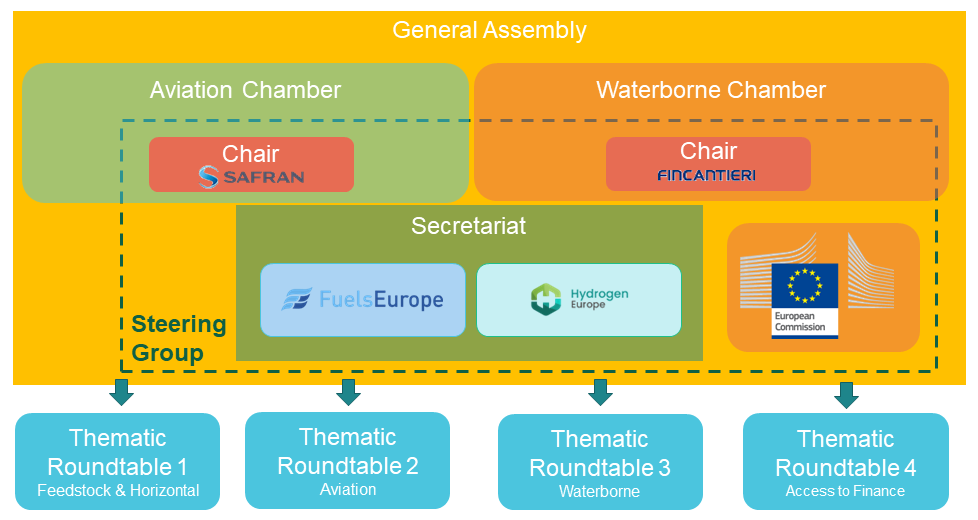
After more than two years of successful development and deliverables by the four thematic Roundtables, the Alliance has introduced a new structure to propose a more efficient working method at its General Assembly in December 2024. A Program and Monitoring Group (P&MG) is composed of 20 members following an internal call for expression of interest call. It has merged the former 4 Roundtables and will develop the work plan of the Alliance. In addition, more activities will involve all Alliance members (dissemination exercises), specific deliverables will be provided by ad-hoc task forces (e.g. the Labelling task force).

All members of the alliance have the right to participate in the General Assembly.
The General Assembly discusses and endorses the alliance work plan for the coming year, with operational objectives and milestones proposed by the P&MG. Members implement the work plan through specific task forces and disseminate the work in webinars or workshops. Their work is supported by an Alliance Secretariat.
Timeline
- 26 February 20264th General Assembly of the RLCF Alliance
26 February 2026, 9:00 - 18:00
Venue: Alcide de Gasperi Room, Charlemagne Building, Rue de la Loi 170, 1040 Bruxelles, Belgium
Format: full day, in-person meeting
The 4th General Assembly of the RLCF Alliance, now scheduled for 26 February 2026. The event will be held in the European Commission's Charlemagne Building in Brussels, from 9:00 to 18:00.
Registration and agenda. Please register before 15 February 2026.
NOTE: Registration is mandatory to access the venue. Before the event you will receive a personal invitation from the European Commission V-PASS system to access the venue. You will be admitted to the RLCF Alliance General Assembly only after completing the V-PASS registration.
- 6 December 20243rd General Assembly of the RLCF Alliance
Open to Alliance members
- 3-6 September 2024RLCF Alliance matchmaking and showcasing at SMM in Hamburg
Open to Alliance members
- 6 June 2024RLCF alliance matchmaking and showcasing at ILA Berlin
Open to Alliance members
- 4 April 2024RLCF Alliance matchmaking and showcasing at Connect Europe Days
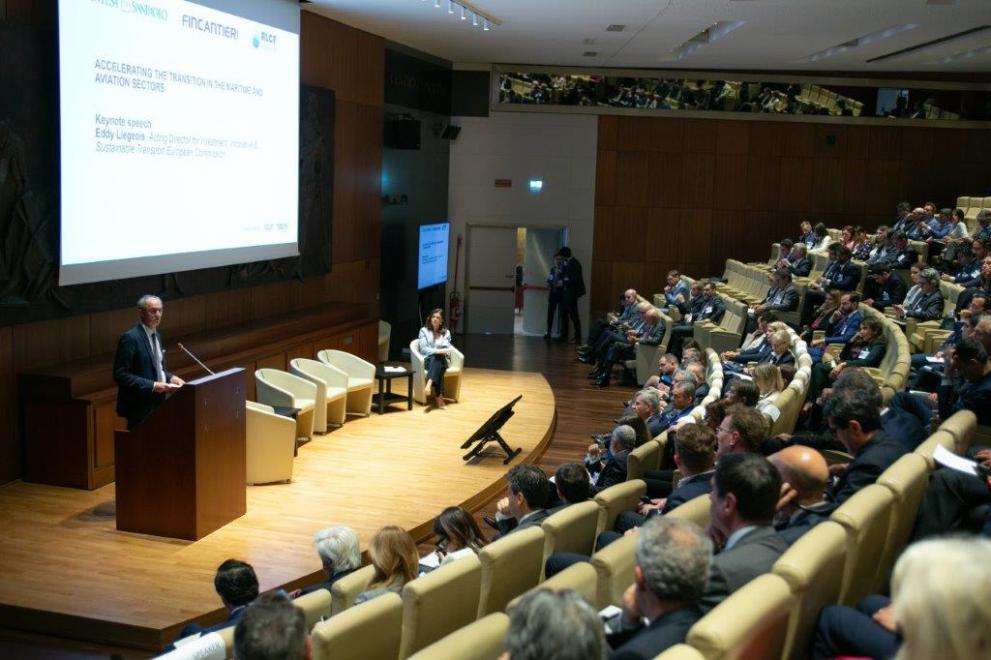
- 16 October 2023Second General Assembly meeting
Participation open to all the Alliance member organisations
- 22 September 2022Open call to delegate experts to participate in thematic roundtables
- 27 June 2022Proposal of the framework work plan
- 6 April 2022Open call for expressions of interest to join the Alliance
Highlights

- General publications
- 16 May 2023

- General publications
- 28 February 2024
Recent webinars

24 November 2025

6 February 2025

21 November 2024


22 January 2024

10 October 2023

27 June 2023

23 June 2023